Guide · Bankroll & staking
Bankroll Management for Sports Betting: Why Flat Staking Beats Gut Feel
Most bettors who lose don't lose because their picks are bad. They lose because their staking is. The same set of picks can be profitable at flat stakes and ruinous with "confidence" sizing. Here's the boring system that outlives the exciting ones.
First: what a bankroll actually is
A bankroll is money set aside for betting that you can afford to lose entirely — separate from rent, savings, and anything with a deadline. If losing it would change your life, it's not a bankroll. That line isn't a disclaimer; it's the design constraint every staking plan is built on.
The unit: 1% and stop thinking about it
A unit is your standard stake, and the sane default is 1% of your bankroll. A €1,000 bankroll means €10 bets.
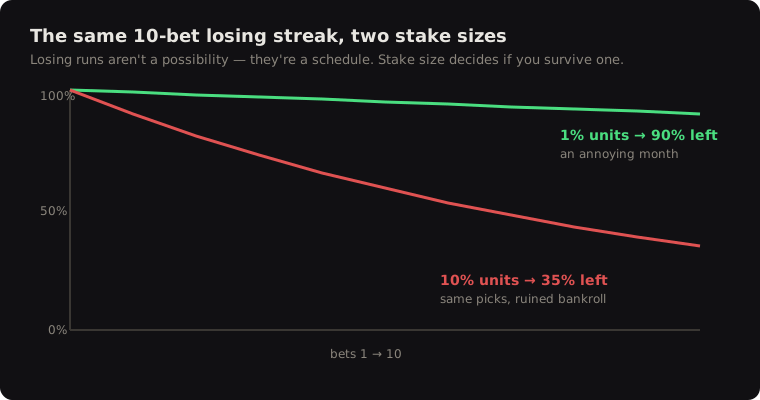
Why so small? Because losing runs are not a possibility — they're a schedule. Even a genuinely good bettor hitting 55% at even money will see streaks of 8–10 losses. At 1% a unit, that's an annoying month. At 10% a unit, it's the end of the bankroll — with the same picks.
Staking size isn't about maximising the good weeks. It's about surviving the guaranteed bad ones.
Flat staking: the discipline machine
Flat staking means every pick gets the same one unit, no exceptions. Its power is what it removes:
- No chasing — you can't double up after losses, which is how most bankrolls actually die.
- No hindsight editing — a record at flat stakes can't be dressed up by claiming the winners were "max plays."
- An honest ROI — profit per unit risked becomes directly comparable across weeks, sports, and tipsters.
This is why the Three Pundits public scorecard is graded at flat one-unit stakes. Not because it's theoretically optimal — because it's verifiable. Anyone can recompute our ROI from the published picks.
What about betting more when you're confident?
There's real theory here (Kelly staking — sizing by the edge). The catch: it only works if your probabilities are accurate, and it punishes overconfidence brutally. Overestimate your edges — which almost everyone does — and Kelly has you betting biggest exactly where you're most wrong.
Our own approach: flat stakes on the public record, while conviction-based sizing runs silently in the background until enough settled picks exist to prove the conviction ratings actually calibrate. Until sizing earns trust with data, it doesn't touch the record. We'd suggest the same standard for your own betting.
The five rules, on a napkin
- Bankroll = money you can lose entirely.
- One unit = 1% of it.
- Every bet is one unit.
- Never raise stakes to chase a loss.
- Re-size the unit only on a schedule (say, monthly) — not after a big night either way.
Boring. That's the point. The excitement is supposed to come from the games.
See the flat-stake record in public — every pick, every price, wins and losses alike: threepundits.com/scorecard.
This is general information, not financial or betting advice. Never bet money you can't afford to lose. 18+ · bet responsibly.