Guide · The tipster audit
How to Spot a Fake Tipster Record: 7 Checks Before You Trust Anyone's Picks
The tipster industry has a math problem: everyone is profitable. Scroll through Telegram or X and you'll find wall-to-wall 70% win rates and "another green week 💰." Real betting doesn't look like that — so most of what you're seeing is either luck, selection, or fabrication. Here's how to tell which, in seven checks.
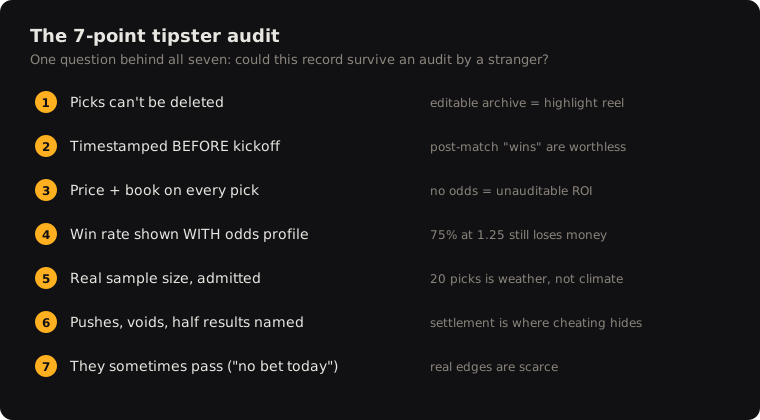
1. Can picks be deleted?
The oldest trick: post picks, delete the losers, screenshot the survivors. If the record lives somewhere editable — a Telegram channel where messages vanish, a feed that can be pruned — it's not a record, it's a highlight reel.
What to look for: picks published somewhere with visible timestamps that can't be quietly removed, and an archive that includes losses.
2. Was the pick published before the match?
A timestamp after kickoff is worthless. Some services post "wins" retroactively or edit the pick text after the result. The gold standard is proof the exact pick — market, price, stake — existed before the game started, in a form that can't be edited afterwards.
(This is the reason every Three Pundits pick is cryptographically timestamped before kickoff — a mass-market way of saying: we can prove we didn't edit history, and you can check.)
3. Is there a price and a book on every pick?
"Chelsea win ✅" is not a pick. A pick is a market, a price, and where that price was available. Without odds, a record can't be audited — and a tipster quoting prices no real book offered is manufacturing ROI.
4. Does the win rate come with the odds profile?
A 75% win rate on 1.25 favourites loses money. A 40% win rate at 3.00 prints it. Any headline win rate without the average odds next to it is an incomplete sentence — usually deliberately. Look for ROI at flat stakes; it's the number that's hardest to dress up.
5. How big is the sample — and do they admit it's small?
Twenty picks proves nothing, good or bad. Luck dominates until the sample reaches hundreds. The tell isn't the small sample itself — everyone starts somewhere — it's whether they say so. Honest operators flag their own hot streaks as variance. Sellers extrapolate a hot fortnight into a lifestyle.
6. Are pushes, voids, and half results named?
Settlement is where quiet cheating lives: pushes counted as wins, half losses hidden, voided bets silently dropped from the denominator. An honest record states its grading rules and names the no-action bets right on the page.
7. Do they ever pass?
A service that fires picks every single day, every sport, is optimising for content volume, not edge. Real edges are scarce. "No bet today" is one of the strongest signals a record is real — passing costs a seller engagement, and they pay it anyway.
The pattern behind all seven
Every check reduces to one question: can this record survive an audit by a stranger? If the answer is yes, the operator will have made auditing easy, because verifiability is their best marketing. If the answer is no, the record is a story.
We built Three Pundits to pass all seven in public — timestamped picks, prices and books named, flat stakes, losses on the record forever, pushes named, and pass days when the room doesn't like anything. Audit us: threepundits.com/verify.
This is general information, not betting advice. 18+ · bet responsibly.