Guide · Closing line value
What Is Closing Line Value (CLV) in Sports Betting? A Plain-English Guide
Ask a casual bettor how they're doing and they'll tell you their record. Ask a professional and they'll tell you their closing line value. Here's why those are different questions — and why the second one matters more.
The short version
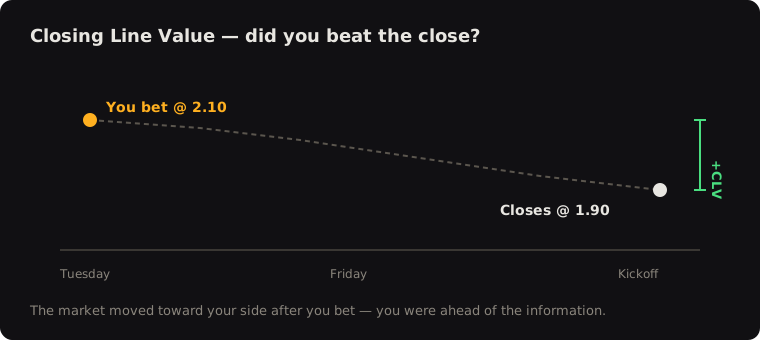
Closing line value is simple: compare the odds you bet at with the odds just before kickoff (the "closing line"). If you took 2.10 on a team and the market closed at 1.90, you beat the close. If it closed at 2.30, the market moved against you.
Do that once and it means nothing. Do it across hundreds of bets and it becomes the most honest report card in betting.
Why the closing line is the benchmark
The closing line is the market's final answer after every piece of information — team news, sharp money, injury updates, weather — has been priced in. It's the most accurate number the market ever produces for that game.
So beating it consistently means one thing: you knew something before the market fully priced it. That's what an edge actually is.
Why CLV beats win rate as a measuring stick
Results are noisy. A coin-flip bettor can run hot for 50 bets and look like a genius; a genuinely sharp bettor can lose for a month and look like a mug. Luck dominates small samples, and "small" in betting means hundreds of bets, not dozens.
CLV cuts through that noise much faster. Whether the bet won or lost, the line move tells you whether you were on the right side of the information. A bettor who beats the close on 55% of their bets is almost certainly good. A bettor with a 65% win rate over 40 bets might just be lucky.
The uncomfortable corollary: a profitable record with bad CLV is usually luck wearing a costume. It runs out.
How the pundits use it
At Three Pundits, the public scorecard leads with the numbers everyone understands — record, ROI, profit in units. But behind the bar, CLV is the calibration gate. Every settled pick gets its closing odds captured, and we track whether the room's picks beat the close. When a category of picks stops beating it, that category gets benched — no matter what the win rate says.
That's the deal we've made with variance: results tell the story, CLV keeps us honest about whether the story means anything yet.
How to track your own
- Record your odds at bet time.
- Record the closing odds on the same market (any sharp book works as reference).
- After 100+ bets, check the percentage where your price beat the close.
Above ~52% consistently, you may have something. Below it, the market is telling you to change your process — not your stake size.
Want to see it applied to real picks? Every pick we publish is timestamped and settled in public, win or lose: threepundits.com/scorecard.
This is general information about how betting markets work, not betting advice. 18+ · bet responsibly.